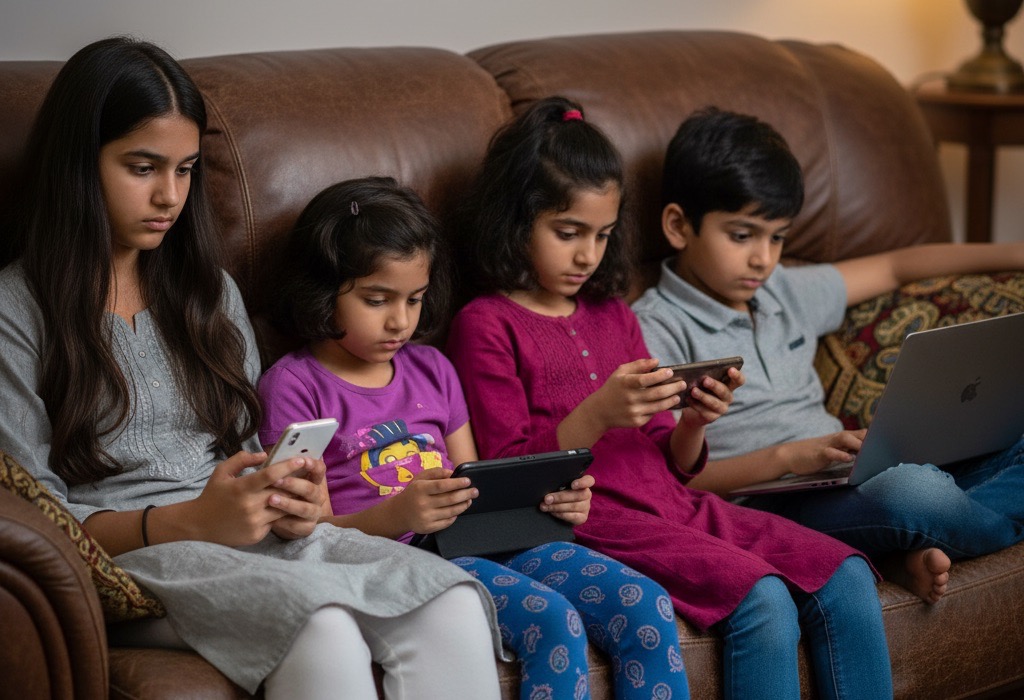
Screen Time for Kids: Are Screens Becoming the Default Babysitter?
A practical, evidence-based guide for Indian parents of children aged 2–10, with guidance that also applies to older children and family media routines.
Written by: Plazmo Product Team — designers and engineers building camera-based motion games for children and families in India.
Published: August 10, 2026 · Last updated: August 10, 2026
Reading time: 15 minutes

Many parents do not hand over a phone or switch on the television because they believe it is the best activity for their child. They do it because dinner has to be cooked, a work call cannot be postponed, travel is exhausting or everyone needs ten quiet minutes.
The real question is therefore not whether parents ever use screens as practical help. It is whether screen time for kids has become the automatic answer to boredom, meals, distress and every gap in the day and what that repeated pattern may gradually displace.
The direct answer
Screens become the default babysitter when they are the automatic response to boredom, meals, tantrums or a parent’s need to work, not when they are used occasionally and deliberately. The concern is less one isolated session than a repeated pattern that displaces sleep, conversation, movement, free play or practice handling emotions. Age, content, context and family circumstances still matter.
Table of contents
- When does screen time for kids become a default babysitter?
- Why do parents rely on screens so often?
- Is occasional screen use as a break harmful?
- What does the research actually show?
- How should screen use change by age?
- What can default screen use displace?
- What are the real risks and trade-offs?
- How can parents reset the habit without banning screens?
- Is this screen activity a good fit?
- How does Plazmo approach this problem?
- What can screens, active gaming and this guidance not solve?
- So, are screens becoming the default babysitter?
- Frequently asked questions
When does screen time for kids become a default babysitter?
“Default babysitter” is not a medical diagnosis. In this article, it describes a family pattern: a screen is offered automatically whenever a child is bored, waiting, eating, upset or inconveniently energetic.
The distinction is important because an occasional planned programme while a parent finishes urgent work is not the same as a device becoming the child’s main source of calming, entertainment and supervision.
Look for the pattern, not one difficult day
A screen is more likely to have become the default when several of these are true most days: the child expects a device at every meal or car ride; boredom immediately leads to asking for a screen; stopping consistently causes major conflict; adults use a device before trying another response; or screen use regularly pushes aside sleep, conversation, outdoor time, homework or unstructured play.
The number of minutes still matters, especially for younger children, but current paediatric guidance increasingly asks parents to examine the quality, context and function of media use as well.
The American Academy of Pediatrics (AAP) notes that one universal time limit cannot capture the needs of every older child; parents should also ask what media is crowding out and how it is designed to hold attention.[4]
Why do parents rely on screens so often?
Because screens work quickly. They are portable, predictable, inexpensive once purchased and capable of holding a child’s attention while an adult completes something necessary.
Treating this only as a discipline failure is lazy analysis. Parents may be dealing with long commutes, small homes, unsafe outdoor spaces, limited childcare, demanding jobs, multigenerational responsibilities or a child who needs unusually intensive supervision.
A 2023 systematic review of 20 qualitative studies covering 1,311 parents found that families described multiple reasons for young children’s screen use, along with uncertainty and conflict about how to manage it.[10]
The AAP’s 2026 technical report similarly recognises that caregiver stress, limited time and broader social conditions shape children’s media environments.[3]
The useful question is: what job is the screen doing?
Before changing the habit, identify its function. Is the screen buying time for cooking? Keeping the child seated during feeding? Preventing conflict between siblings? Calming distress? Filling a long commute? Giving the parent a necessary break?
Different jobs require different alternatives. Telling a parent simply to “reduce screen time” without replacing the function is unlikely to work.
Is occasional screen use as a break harmful?
There is no good evidence that one planned cartoon, game or video call turns an otherwise balanced childhood into a harmful one. Research rarely supports such all-or-nothing claims.
The more defensible concern is cumulative: repeated use can become a habit, some content is designed to resist stopping, and media can displace experiences children also need.
UNICEF’s 2025 review cautions against treating screen time alone as a complete measure of digital harm. It found no clear evidence that time on screens by itself directly causes poor mental health. The nature of online experiences including harmful content, bullying and exploitation can matter more.[9]
That does not make unlimited use harmless. It means parents should avoid simplistic equations such as “all screens are bad” or “educational content is always good.”
Planned help is different from automatic dependence
A reasonable use may have a defined purpose, age-appropriate content, a clear stopping point and no major activity being sacrificed.
Default use has no real decision behind it: the device appears because the child is present and the adult needs the situation to become easier. The goal is not parental perfection. It is to create enough alternatives that screens are one tool rather than the only tool.
What does the research actually show?
The research base is useful but weaker than headlines often suggest. Many studies are observational, rely on parent-reported screen time and measure different devices, content and family contexts.
Associations can identify patterns; they cannot automatically prove that screens caused the outcome.
Parent behaviour is consistently linked with young children’s screen use
A 2025 systematic review examined 87 studies published from 1982 to 2023 involving children aged five or younger. Individual samples ranged from about 45 to 10,967 participants.
Parental modelling was positively associated with children’s screen use in 59 of 70 tested associations, while rules, mealtime restrictions and parent confidence were often associated with lower use.[5]
However, 78 of the 87 studies were cross-sectional, eight were longitudinal and only one was a randomised trial. All screen measures were parent-reported, and the review could not conduct a meta-analysis because methods differed substantially.
The finding supports changing the family environment; it does not prove that any single parenting rule will produce a specific developmental result.
Using devices to calm preschoolers may reinforce a difficult cycle
A US cohort study followed 422 parent-child pairs with children aged three to five for six months. More frequent use of mobile devices to calm children was associated with greater emotional reactivity over time, with stronger patterns among boys and children described as having high surgency or intense positive emotion.[6]
The relationship appeared bidirectional: emotionally reactive children may be given devices more often, and frequent device-calming may reduce opportunities to practise other regulation strategies.
The study was observational, used a convenience sample and parent reports, and cannot establish causation. It should not be converted into the claim that a phone causes tantrums.
Parent education can reduce screen exposure in infancy
An open-label randomised controlled trial at a tertiary hospital in Delhi enrolled 120 healthy infants aged nine to ten months.
After six months, parents who received structured education reported a median of 35 minutes of daily screen exposure, compared with 75 minutes in the control group; 3% versus 53% exceeded one hour a day.[7]
This is stronger evidence that specific guidance can change reported behaviour, but it was a single-centre infant study, was not blinded and relied on parent reports.
It does not tell us that the same programme will work for an eight year old, or that reducing screen time alone guarantees better development.
Content and co-use matter, but they do not erase displacement
A 2020 meta-analysis combined 42 studies with 18,905 children. Greater overall screen quantity was associated with slightly weaker language skills, while educational programming and co-viewing were associated with slightly stronger skills.[8]
These were small associations and much of the evidence was observational. “Educational” is therefore not a free pass for unlimited viewing; shared discussion and the activity being displaced still matter.
How should screen use change by age?
Age guidance should become less about mechanically counting minutes as children grow and more about protecting sleep, school, movement, relationships and safe digital participation.
For younger children, firm limits and adult involvement matter more because they have less ability to understand persuasive design, manage stopping or transfer what they see on a screen to real life.
| Age | Practical guidance | What parents should protect |
|---|---|---|
| Under 2 years | Avoid routine screen exposure, except limited video calling with adult involvement. Do not use screens for feeding or calming. | Prioritise face-to-face interaction, floor play, sleep and responsive caregiving. |
| 2–5 years | IAP recommends no more than one hour a day, supervised, preferably in 20–30-minute sessions. | Choose slow, age-appropriate content; co-view or co-play; keep meals and bedtime screen-free. |
| 5–10 years | IAP recommends less than two hours of sedentary recreational screen time a day. | Protect sleep, schoolwork, daily movement, family conversation and independent play. |
| 10–15 years | Use a family plan rather than relying on one number alone; review content, privacy, online contact, purchases and what use displaces. | Agree on boundaries with the child, keep devices out of bedrooms overnight and build digital judgement. |
The Indian Academy of Pediatrics provides the clearest India-relevant age guidance: no screen use below two years apart from supervised video communication; no more than one hour a day from two to five; and less than two hours of sedentary recreational screen time from five to ten, without replacing sleep, activity, study or family time.[1]
WHO’s under-five guidance also treats sleep, physical activity and sedentary time as parts of one 24-hour routine rather than separate targets.[2]
These are population-level guides, not a diagnosis. Children with disabilities, medical needs or communication differences may use screens or assistive technology differently.
Families should discuss individual concerns with an appropriately qualified professional rather than applying a generic rule rigidly.
What can default screen use displace?
The central issue is opportunity cost. A child cannot spend the same minute both watching a video and talking with a parent, building with blocks, climbing, sleeping or inventing a game.
Screen use becomes more concerning when it repeatedly replaces activities that are harder to organise but developmentally valuable.
- Sleep: late or stimulating use can delay bedtime, while devices in bedrooms make limits harder to enforce.
- Conversation: background television and individual devices can reduce back-and-forth interaction during meals and routines.
- Movement: sedentary viewing may replace active play, especially when indoor space or outdoor access is already limited.
- Free play: children need periods without pre-selected entertainment to invent, explore and tolerate boredom.
- Emotional practice: if every frustration is immediately interrupted by a device, the child gets fewer chances to calm with adult support, movement, language or time.
- Family attention: adult device use also matters. A child cannot follow a boundary that adults visibly ignore.
The AAP’s technical report describes this as “displacement” or erosion of offline opportunities and notes that autoplay, endless feeds and other design choices can capture attention beyond the user’s original intention.[3]
What are the real risks and trade-offs?
| Question | Planned screen use | Default babysitter pattern | Shared or active screen use |
|---|---|---|---|
| Purpose | Chosen for a specific reason | Used automatically to manage any difficult moment | Chosen to combine media with movement or family participation |
| Adult involvement | May be independent or shared | Usually used to remove the need for interaction | Often works better with setup, supervision or co-play |
| Stopping point | Agreed before starting | Unclear; stopping is negotiated during conflict | Set by rounds, turns or a planned session |
| Main benefit | Entertainment, learning or rest | Immediate quiet and convenience | Entertainment plus movement or social play |
| Main risk | Poor content choice or excessive duration | Dependence, conflict and displacement of other routines | Still screen-based; physical safety and routine balance remain necessary |
| Best use | One option within a varied day | Emergency use, not the everyday default | A planned alternative to sedentary gaming, not a replacement for outdoor or free play |
The trade-off is not simply screen versus no screen
A quiet television programme may be safer than an exhausted parent trying to supervise cooking and an energetic toddler at the same time. A video call with grandparents can support a relationship. A well designed game can be social or active.
Conversely, a so called educational app can still be manipulative, advertisement heavy or difficult to stop. Parents need to judge the whole situation, not the label on the content.
Watch for risks beyond duration
- Persuasive design: autoplay, streaks, endless feeds and variable rewards can make stopping difficult.
- Inappropriate content: age ratings do not guarantee that every video, advertisement or user-generated interaction is suitable.
- Privacy: cameras, microphones, accounts and analytics may collect more data than parents expect.
- Online contact: open chat, public profiles and interaction with strangers introduce risks unrelated to screen duration.
- Commercial pressure: advertising, loot boxes and repeated in-app purchases can exploit children’s limited understanding.
- Physical setup: active experiences require clear floor space, suitable footwear, sensible intensity and adult judgement.
How can parents reset the habit without banning screens?
A total ban is usually unnecessary and may be unrealistic. The more effective target is the automatic trigger: the moments when an adult reaches for a device before making a decision.
Change one repeated situation first rather than attempting to redesign the entire family routine overnight.
- Track the triggers for three days. Note when the screen starts, what the child was doing, what the adult needed and what activity was displaced. Do not change anything yet; find the pattern.
- Choose one default moment. Start with the easiest repeated situation, such as breakfast, the first 20 minutes after school or waiting at a restaurant. Do not begin with the family’s hardest crisis point.
- Replace the job, not only the device. For cooking time, prepare a nearby activity box. For travel, use audio stories, drawing or observation games. For distress, try connection, water, breathing, movement or a quiet space before media.
- Make screen use predictable. State when it will start, what will be used and when it will end. Prefer a complete episode, fixed round or visible timer over an endless feed.
- Change the environment. Keep devices out of sight when not in use. Disable autoplay and non-essential notifications. Avoid leaving background television on.
- Expect protest without reversing the boundary. A child can be upset about stopping and still be safe. Acknowledge the feeling, hold the limit and offer two acceptable next activities.
- Model the rule. Adults should put away their own phones during the same meals, conversations or bedtime routines they are protecting for the child.
- Review after two weeks. Look for fewer automatic starts, smoother stopping and more varied play—not perfect compliance or a zero-screen household.
Build a low-effort alternative menu
Alternatives fail when they require more preparation than the exhausted parent can manage. Keep a small set ready: reusable stickers, large crayons, magnetic tiles, picture books, a soft ball, music-and-movement prompts, simple household “jobs,” audio stories and a basket used only during work calls. Rotate items rather than buying more.
The Delhi trial suggests that clear parent education and a concrete plan can reduce reported screen exposure, at least in infancy.[7]
The broader parenting review also indicates that modelling, consistent rules and confidence are more useful targets than repeatedly blaming the child.[5]
Parent checklist: is this screen activity a good fit?
- I know why we are using this screen now.
- The content or game is suitable for my child’s age and abilities.
- I have checked whether it contains advertising, manipulative rewards or in-app purchases.
- I understand what personal data, camera or microphone access it uses.
- It does not expose my child to open chat or strangers without appropriate safeguards.
- We have agreed on a clear ending point before starting.
- It is not replacing sleep, meals, schoolwork, outdoor time or important family interaction.
- The child can usually stop with normal support, even if disappointed.
- For active play, the area is clear and the movements are physically appropriate.
- I am not relying on the screen as the only way to feed, calm or occupy my child.
- Our adults model at least some of the same device-free boundaries.
- I would still choose this activity if the word “educational” were removed from its marketing.
A “no” does not automatically make the activity unacceptable. It identifies what needs attention: a privacy setting, a shorter session, a different app, more supervision or an alternative for that particular moment.
How does Plazmo approach this problem?
Plazmo is an India-built motion gaming console designed for children aged 4+ and family co-play. It connects to a television through HDMI and uses an integrated camera with on-device vision AI to translate body movements such as jumping, leaning, dodging, swinging, slicing, running and squatting into game controls.
The relevant design choice is not that Plazmo removes screens. It does not. The aim is to make a planned gaming session less sedentary and, where appropriate, more social.
Body movement is the primary control method, so no wearable sensor is required during gameplay. Movement processing happens on the console, and camera video is not uploaded for body tracking.
- Designed primarily for children aged 4–15 and family co-play
- Body movement is the primary gameplay control method
- No wearable sensor is required during play
- Movement processing happens locally on the console
- Games are curated for children and families
- No open chat or interaction with strangers
- No third-party advertising in games
- Core gameplay can work offline; internet may be needed for software updates and game downloads
These choices reduce some common concerns around open online environments, advertising and passive play; they do not remove the need for parental judgement, time boundaries or a safe play area.
What has Plazmo observed during product development?
During early Plazmo product testing, we observed that children understood games more quickly when the on-screen action closely matched a familiar body movement, such as jumping, leaning or swinging. We also found that shorter rounds and clear visual feedback helped younger players understand whether their movement had been recognised. These observations influenced how we design Plazmo games.
These are internal product-development observations, not findings from a controlled scientific study.
Plazmo is a consumer gaming product, not a medical device.
Some families need individual guidance
Children with epilepsy triggered by visual stimuli, mobility limitations, sensory sensitivities, developmental differences, injuries or medical restrictions may require tailored advice or modified activities.
A child who persistently loses sleep, becomes extremely distressed around devices, encounters harmful content or shows a major change in mood or functioning may need support from a paediatrician, psychologist or another appropriately qualified professional.
So, are screens becoming the default babysitter?
In many homes, yes but usually because screens solve a real practical problem faster than the available alternatives.
The useful response is not shame or a dramatic household ban. It is to notice when a device has become automatic, identify the job it is doing and protect the experiences being displaced.
Younger children need firmer limits and more adult involvement; older children need clear boundaries around content, privacy, sleep and online interaction.
Planned screen use can remain part of family life. It becomes a problem when every meal, wait, emotion or quiet moment requires it.
Start with one recurring trigger, build an easier alternative and make digital use predictable. A balanced routine is not one with no screens. It is one in which screens do not silently organise the whole day.
Frequently asked questions
Sources
- Indian Academy of Pediatrics. Indian Academy of Pediatrics Guidelines on Screen Time and Digital Wellness in Infants, Children and Adolescents. Indian Pediatrics. 2022.
- World Health Organization. Guidelines on Physical Activity, Sedentary Behaviour and Sleep for Children Under 5 Years of Age. 2019.
- American Academy of Pediatrics. Digital Ecosystems, Children, and Adolescents: Technical Report. Pediatrics. 2026.
- American Academy of Pediatrics. Screen Time Guidelines. Updated 2025.
- Pyne B, Asmara O, Morawska A. The Impact of Modifiable Parenting Factors on the Screen Use of Children Five Years or Younger: A Systematic Review. Clinical Child and Family Psychology Review. 2025.
- Radesky JS, Kaciroti N, Weeks HM, Schaller A, Miller AL. Longitudinal Associations Between Use of Mobile Devices for Calming and Emotional Reactivity and Executive Functioning in Children Aged 3 to 5 Years. JAMA Pediatrics. 2023.
- Poonia Y, Khalil S, Meena P, Shah D, Gupta P. Parental Education for Limiting Screen Time in Early Childhood: A Randomized Controlled Trial. Indian Pediatrics. 2024.
- Madigan S, McArthur BA, Anhorn C, Eirich R, Christakis DA. Associations Between Screen Use and Child Language Skills: A Systematic Review and Meta-analysis. JAMA Pediatrics. 2020.
- UNICEF Innocenti. Childhood in a Digital World: Screen Time, Digital Skills and Mental Health. 2025.
- Chong SC, Teo WZ, Shorey S. Exploring the Perception of Parents on Children’s Screentime: A Systematic Review and Meta-synthesis of Qualitative Studies. Pediatric Research. 2023.
Plazmo is a consumer gaming product, not a medical device or healthcare service. This article provides general educational information and does not replace professional medical, developmental or mental-health advice. Seek appropriately qualified advice for concerns specific to your child.