Active Gaming for Kids: Is It Better Than Passive Screen Time?
A practical, evidence-based guide for parents considering movement-controlled video games for children aged 4–15.
Written by: Plazmo Product Team — designers and engineers building camera-based motion games for children and families in India.
Published: July 30, 2026 · Last updated: July 30, 2026
Reading time: 9 minutes

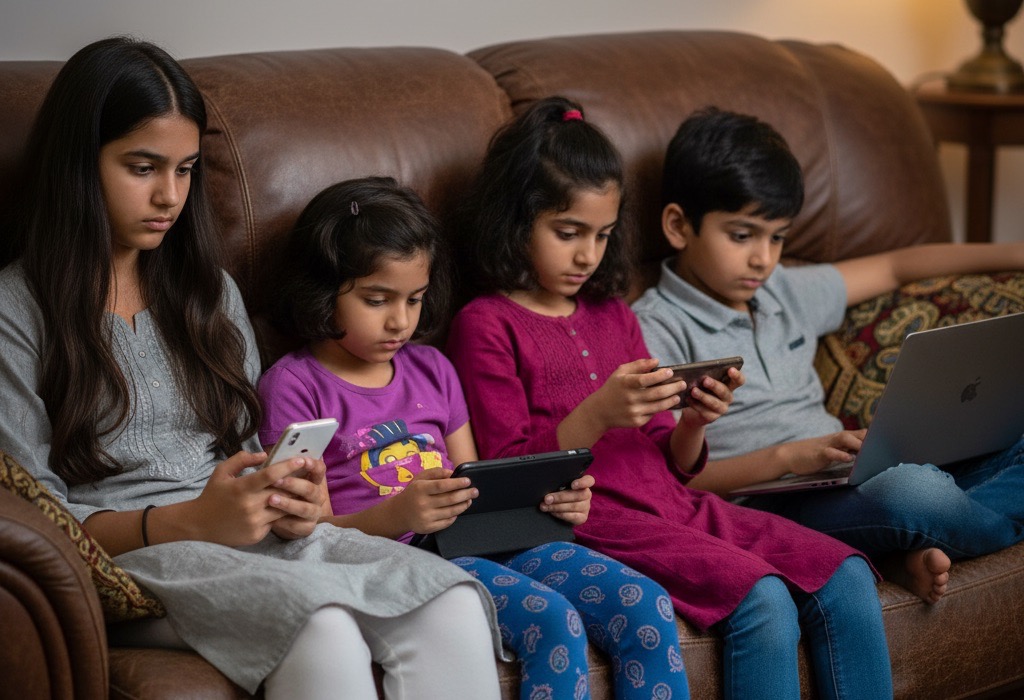
Many parents are not trying to eliminate screens completely. They are trying to make better choices about what children do on screens, how long they do it and what that screen use replaces. Active gaming is one possible option because it combines digital play with physical movement.
The direct answer
Active gaming uses movements such as jumping, leaning, dodging and swinging to control a video game. Research shows that selected active games can raise physical activity during play, making them more active than seated gaming. However, active gaming should complement—not replace—outdoor play, sport, adequate sleep and the broader daily movement children need.
Table of contents
- Is all screen time equally harmful for children?
- What is active gaming?
- Can active gaming actually help children stay active?
- Can it replace outdoor play or sport?
- Which ages is active gaming suitable for?
- How should parents evaluate an active game?
- What has Plazmo learned from early testing?
- How should families use active gaming responsibly?
- Frequently asked questions
Is all screen time equally harmful for children?
No. “Screen time” describes a delivery medium, not a single behaviour. Watching endless short videos alone, video-calling a grandparent, creating digital art and playing a movement-controlled game are different experiences.
The American Academy of Pediatrics advises families to look beyond one universal time limit and consider the child, the content, whether media is being used for calming, what it displaces and how communication works around it.[1]
Parents should still set boundaries. The point is not that active gaming makes unlimited screen use harmless. The point is that the quality and context of a screen activity matter alongside duration.
Questions parents should ask about any screen activity
- Is my child sitting passively or moving?
- Is the content age-appropriate and free from manipulative advertising?
- Is my child playing alone, with strangers or with family?
- Does it displace sleep, meals, schoolwork, outdoor play or friendships?
- Can my child stop without repeated conflict?
What is active gaming?
Active gaming—also called exergaming—is digital play in which physical movement controls the game. Players may jump, lean, dodge, squat, dance, swing their arms or move around a defined play area.
The important distinction is that movement is not merely encouraged between levels. It is required for the game to respond.
How is active gaming different from conventional gaming?
| Conventional gaming | Active gaming |
|---|---|
| Usually controlled with buttons, sticks or touch | Controlled through body movement |
| Often played while seated | Usually requires standing and moving |
| Movement is separate from gameplay | Movement drives gameplay |
| Physical intensity is generally low | Intensity varies from light arm movements to vigorous full-body play |
| Can be solo or multiplayer | Can also support solo, cooperative and competitive family play |
Not every active game is equally active. Game design, movement type, difficulty, session length and whether a child discovers a low-effort shortcut all affect actual physical intensity.
Can active gaming actually help children stay active?
It can make a gaming session more physically active, but it does not guarantee that a child becomes more active overall.
In a laboratory study involving 39 children aged 9–13, all six tested exergames increased energy expenditure above rest. The selected games produced moderate-to-vigorous intensity during the short test sessions.[2]
However, short-term intensity and long-term behaviour are not the same thing. A naturalistic study found that simply giving children active video games did not lead to an overall increase in physical activity.[3] A 2025 six-month randomised controlled trial also found no consistent increase in daily moderate-to-vigorous activity across the full intervention, although one group showed a temporary increase during the first three months.[4]
The evidence therefore supports a narrow but useful conclusion:
Active gaming can turn some seated gaming time into moving time. Whether it improves a child’s overall activity depends on the game, continued engagement and what the activity replaces.
What benefits are reasonable to expect?
- More body movement during the gaming session
- An indoor activity option when outdoor play is difficult
- A more approachable entry into movement for some children
- Opportunities for siblings and parents to play together
- Repeated practice of game-specific actions involving timing and spatial awareness
Claims about guaranteed weight loss, improved concentration, better sleep, stronger muscles or developmental outcomes require product-specific evidence. They should not be assumed merely because a game uses movement.
Can active gaming replace outdoor play or sport?
No. Outdoor play provides experiences an indoor video game cannot fully reproduce: sunlight, varied terrain, open-ended exploration, social negotiation and a wider range of physical movements.
The World Health Organization recommends that children and adolescents aged 5–17 average at least 60 minutes of moderate-to-vigorous physical activity per day across the week, including vigorous activity and activities that strengthen muscle and bone on at least three days each week.[5]
Active gaming can contribute to an active day, especially during extreme heat, monsoon rain, poor air quality, limited access to safe open spaces or busy family schedules. It should remain one part of a varied routine.
Which ages is active gaming suitable for?
The appropriate age depends on the game’s movement demands, instructions, speed, content and safety requirements. For Plazmo, the primary intended age range is 4–15 years, while selected multiplayer games can also include parents and other family members.
| Age | What parents should prioritise |
|---|---|
| 4–6 years | Simple movements, short sessions, clear instructions and close adult supervision |
| 7–10 years | Varied movement, understandable goals, safe difficulty progression and regular breaks |
| 11–15 years | Greater challenge, competition or cooperation, transparent rewards and balanced gaming limits |
| Family play | Games that can accommodate different heights, abilities and reaction speeds |
Age labels are only a starting point. Parents should also consider the individual child’s coordination, medical needs, ability to follow safety instructions and response to stimulating games.
How should parents evaluate an active game?
Use this checklist before deciding whether a movement-controlled game is a good fit for your family.
- The recommended age range is stated clearly.
- The game requires meaningful movement rather than token gestures.
- Physical intensity is appropriate for the child.
- The required play space is explained.
- There are no sharp objects, loose rugs or fragile items nearby.
- The content is curated and age-appropriate.
- Advertising, purchases, chat and interaction with strangers are controlled.
- Camera and personal-data practices are explained plainly.
- The child can pause and stop without losing unfair rewards or progress.
- Gaming does not displace sleep, meals, schoolwork, outdoor play or relationships.
What has Plazmo learned from building and testing motion games?
Over two years of developing multiple prototypes and conducting early play sessions with children and parents, the Plazmo team arrived at several product-development observations:
- Movement must be the core mechanic. Adding occasional gestures to a conventional game does not create a convincing active-play experience.
- Actions should be immediately understandable. Plazmo therefore prioritises movements such as jumping, leaning, dodging, swinging, slicing and squatting rather than complicated pose sequences.
- Parents judge the entire environment, not only the game. Families repeatedly prioritised curated content, simple setup, privacy, no advertising and the ability for siblings or parents to join.
- Different games create different activity levels. A hand-movement game and a jumping game should not be described as physically equivalent.
- Replay value matters. A product is not useful merely because a child moves once. Games need clear goals, progression, variation and reasons to return.
These are internal product-development observations, not findings from a controlled scientific study.
How does the current Plazmo console apply those lessons?
Plazmo is an India-built motion gaming console that connects to a TV through HDMI. Its integrated camera uses on-device vision AI to translate a player’s body movements into game controls. Gameplay does not require a handheld controller or wearable sensor.
- Designed primarily for children aged 4–15 and family co-play
- Motion-first games built around jumping, dodging, leaning, swinging and related actions
- On-device movement processing; camera video is not uploaded for body tracking
- Curated games without open chat or interaction with strangers
- Core gameplay can work offline; internet may be needed for updates or future game downloads
This describes Plazmo’s product design. It should not be interpreted as a medical, fitness or developmental claim.
How should families use active gaming responsibly?
- Protect sleep. Stop stimulating games well before bedtime and avoid making screens part of the sleep routine.
- Keep outdoor play in the routine. Use active gaming as an additional indoor option, not as the default replacement.
- Prepare the play area. Clear furniture edges, loose rugs, pets, cables and breakable objects.
- Start with shorter sessions. Allow water and rest, particularly for younger children or high-movement games.
- Match the game to the child. Stop if the child experiences pain, dizziness, breathing difficulty or unusual discomfort.
- Co-play occasionally. Parents understand a game’s intensity, rewards and frustrations better by playing it.
- Watch what gaming displaces. Reduce use if it interferes with sleep, meals, schoolwork, outdoor activity or relationships.
Children with medical conditions, movement limitations or recent injuries should follow guidance from an appropriate healthcare professional before vigorous physical play.
So, is active gaming better screen time?
Compared with a video game that keeps a child seated, a well-designed active game can be a better option because movement is built into the experience. That does not make it unlimited, medically beneficial or equivalent to outdoor play.
The sensible position is simple: when children are going to play a video game, parents can choose experiences that ask them to stand up, move and sometimes play with other family members.
Related Plazmo reading
Frequently asked questions
Sources
- American Academy of Pediatrics: The 5 Cs of Media Use
- Bailey BW, McInnis K. A Comparison of the Energy Cost of 6 Forms of Exergaming. JAMA Pediatrics. 2011.
- Baranowski T, et al. Impact of an Active Video Game on Healthy Children’s Physical Activity. Pediatrics. 2012.
- Lu AS, et al. The Impact of Narratives and Active Video Games: A Randomised Controlled Trial. 2025.
- World Health Organization: Physical Activity Fact Sheet
Plazmo is a consumer gaming product, not a medical device or healthcare service. This article provides general educational information and does not replace professional medical advice.